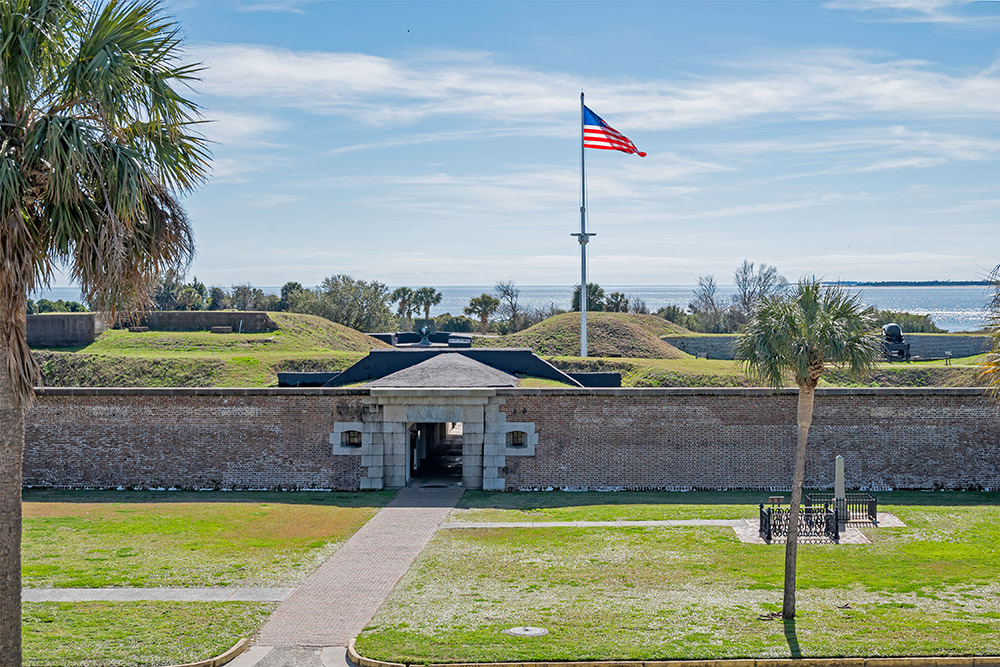
Charleston, South Carolina, established in 1670, is more than just the oldest and largest city in the state; it is a vital, living record of the American South.
Positioned strategically on a peninsula between the Ashley and Cooper Rivers, the city has evolved from a fledgling colonial outpost into one of the most significant ports in North America, a cornerstone of the Confederacy, and finally, a center of historic preservation and culture.
Its story is a complex tapestry of wealth, military conflict, profound racial injustice, and remarkable resilience, often characterized as a “Little London” in the colonial era that grew to be a “Holy City” defined by its skyline of church steeples. Jason Arthur Snyder recently visited the city and briefly summarizes its history below:
Colonial Beginnings and Economic Prosperity (1670–1775)
The story of Charleston begins in April 1670, when English settlers, dispatched by the eight Lord Proprietors who were granted the Carolina territory by King Charles II, established a settlement on Albemarle Point on the west bank of the Ashley River.
By 1680, recognizing the need for a better location, the town—named Charles Towne in honor of the king—relocated to its present location on Oyster Point.The city’s growth was fueled by its advantageous location, allowing it to become a prosperous trade center.
By the early 18th century, Charleston had established a plantation-driven economy focused on the export of rice and indigo. This rapid wealth was heavily built on the forced labor of enslaved Africans, making Charleston a primary center in the American slave trade. Nearly 80% of African Americans can trace their ancestors through this port, highlighting its central role in the tragic history of American slavery.
Despite the brutality of the economy, the city flourished culturally and financially, becoming the wealthiest and largest city south of Philadelphia by the mid-18th century. It was a place of religious tolerance and early cultural development, home to the first established public library, museum, and theatre in America.
Revolutionary War and the “Golden Age”
As tension grew between the colonies and Great Britain, Charleston became a critical player in the American Revolution. The city was a hotbed of patriot activity, hosting tea protests similar to Boston and serving as a home base for revolutionaries.
In 1776, American patriots repelled a British fleet at Sullivan’s Island in a battle that showcased the effectiveness of local palmetto log fortifications.However, the “Golden Age” of colonial Charleston ended with the British Southern Strategy.
In 1780, after a brutal six-week siege, British forces captured the city and took more than 5,000 American soldiers prisoner—one of the worst American defeats in the war. Charleston remained under British occupation until December 1782.
Following the British retreat, the city was incorporated and officially renamed Charleston in 1783. The post-war era brought continued, and even increased, prosperity through cotton, particularly after the invention of the cotton gin in 1793, which solidified the plantation economy.
Antebellum Period and the Civil War (1800–1865)
By the early 19th century, Charleston was at the peak of its antebellum power. It was a sophisticated city characterized by Georgian and Federal-style mansions (famously lining the Battery) and a diverse population. Yet, it was also a city deeply divided and deeply invested in the institution of slavery.
This internal conflict intensified in the 1850s. The city became the cradle of secession, and on December 20, 1860, South Carolina became the first state to pass an ordinance of secession from the Union. The impending war turned into reality on April 12, 1861, when Confederate soldiers under General Pierre G.T. Beauregard fired on the Union-occupied Fort Sumter in Charleston Harbor.
The Civil War was catastrophic for Charleston. The city endured a long, slow bombardment by Union forces, leaving much of its historic area in ruins.
Furthermore, the city was the site of the first successful submarine warfare in 1863, when the H.L. Hunley sank the USS Housatonic. The city was evacuated and surrendered in February 1865, marking a “downward spiral” from which it would take decades to recover.
Reconstruction to Modern Renaissance (1866–Present)
The post-Civil War era was a time of severe economic hardship and slow recovery. The destruction left from the war, compounded by natural disasters like the 1886 earthquake and numerous hurricanes, reduced the city’s prosperity, yet these calamities ironically spared the city from rapid modernization and industrialization, preserving its historic character.In the early 20th century, a renaissance in culture and architecture began.
In 1920, the Preservation Society of Charleston was founded—the first in the United States—focusing on preserving the city’s vast inventory of historic buildings. This move to preserve its, “historic architecture,” rather than replacing it, became a central aspect of its identity and economy.
Beginning in the 1970s and 1980s, under mayors like Joseph P. Riley Jr., the city rehabilitated its downtown, enhanced its tourism sector, and revitalized its historic districts, including Rainbow Row.
Today, Charleston is acclaimed for its well-preserved architecture, its diverse culture—deeply influenced by the Gullah Geechee community—and its status as one of America’s premier historic cities, balancing its profound, sometimes painful, history with its modern, bustling economy.
From its founding in 1670 to the present day, Charleston has endured war, economic swings, and natural disasters, growing from a small, fragile, “Charles Towne” into a city of global significance. Its history is not merely found in books but in its, many historic buildings. The city is a testament to the idea that history can be preserved and learned from, offering a unique glimpse into the defining events of the American South.